
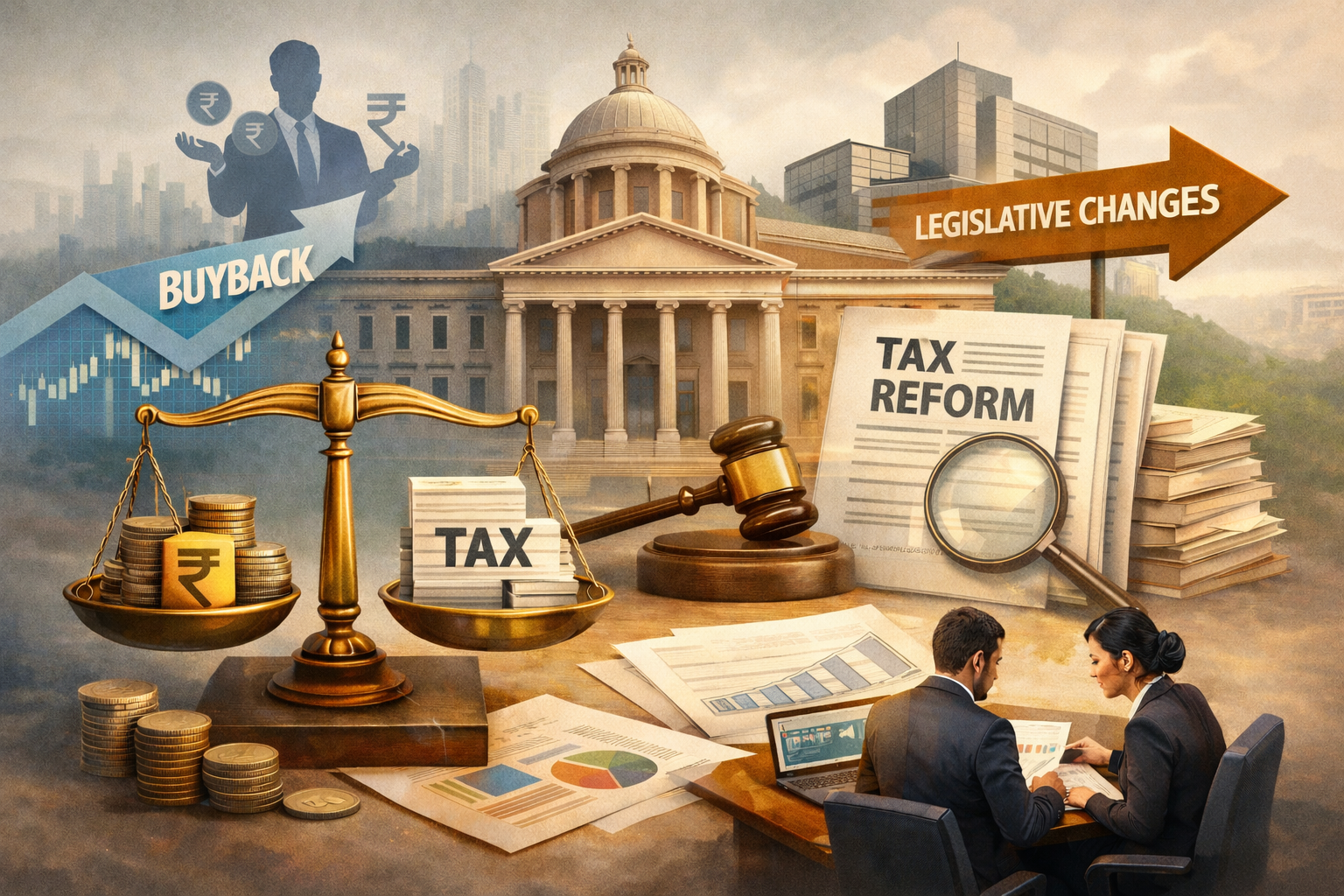
Share buybacks have evolved from a niche corporate tool to a strategic mechanism for returning capital to shareholders. However, their tax treatment has swung dramatically since the 1960s, reflecting changing policy priorities on revenue neutrality and anti-avoidance.
India's buyback framework began with the Companies Act, 1956 (Section 77A), but taxation paradigms pivoted multiple times amid concerns over tax arbitrage between buybacks and dividends.
I. Pre-2013: Shareholder Capital Gains Era
Initially, buybacks were treated as regular share sales, taxing shareholders on capital gains. There was no corporate-level tax. This regime promoted buybacks as efficient exits but lacked anti-abuse safeguards, prevailing until the Finance Act 2013.
II. 2013–2020: Company Bears Buyback Distribution Tax (BDT)
Finance Act 2013 introduced Section 115QA, imposing a flat 20% BDT (effective ~23.3%) on companies. Proceeds were made tax-exempt for shareholders under Section 10(34A). This regime successfully curbed promoter profit extraction without dividends.
III. 2020: DDT Abolition Triggers Realignment
When the Dividend Distribution Tax (DDT) was abolished, dividend tax shifted to shareholders at slab rates. However, BDT continued, creating an arbitrage where companies favored buybacks for tax certainty (23% vs. shareholder slabs up to 42.7%).
IV. Oct 2024: The "Deemed Dividend" Reversal
The Finance (No. 2) Act 2024 reclassified buyback proceeds as deemed dividends under Section 2(22)(f). Shareholders became taxable on the entire consideration at slab rates, while the original cost of acquisition was treated as a separate notional capital loss.
Example: Shares bought at ₹40, bought back at ₹100. Post-Oct 2024, the shareholder pays slab tax on the full ₹100, while carrying forward a ₹40 capital loss for future offset.
V. 2026: Full Circle: Return to Capital Gains
The Finance Bill 2026 reverses the deemed dividend rule, returning buybacks to the capital gains definition. However, to prevent misuse, promoters will now bear a higher effective tax cost as follows:
| Particulars | Promoter (Domestic Co.) | Promoter (Non-Domestic) |
|---|---|---|
| LTCG / STCG Rate | 12.5% / 20.0% | 12.5% / 20.0% |
| Additional Tax Rate | 9.5% / 2.0% | 17.5% / 10.0% |
| Effective Tax Rate | 22.0% | 30.0% |
The new provisions are effective from 1 April 2026. A "Promoter" is defined per SEBI regulations for listed companies, and for unlisted companies, includes any person holding more than a 10% stake.
Conclusion
This rollercoaster reflects India's maturing tax ecosystem. The 2026 reset promises a buyback revival while rewarding long-term minority investors with a favorable 12.5% LTCG rate. Proactive tax planning remains the ultimate competitive edge in this dynamic landscape.